



Most hikers don’t think about wind until they’re already inside a tent that’s shaking at 2 a.m.
If you’re camping with something like the ozark trail 2 person hiker tent, you’ve probably wondered just how much wind the poles can actually take before something gives.
The short answer: less than most people expect. Here’s what the numbers actually look like.
What wind speed will actually break your tent poles?
Most budget tent poles start failing around 25–35 mph sustained wind – which isn’t even close to storm conditions. Fibreglass poles, common in entry-level tents, don’t bend under pressure. They snap. And once they snap, your tent is done for the night.
Aluminium poles handle things differently. A 7001-series aluminium pole can usually hold up to around 35–50 mph before it starts to deform. Higher-end 7075 alloy, which you’ll see in mountaineering tents, pushes that up to the 50–65 mph range.
The real problem isn’t the poles alone, though. It’s the pole-to-fabric connection. Grommets tear, clips pop off, and pole sleeves fail long before the pole itself bends. A gust doesn’t need to break your pole to ruin your night – it just needs to rip the pole out of position.
Does tent shape change how much wind it can handle?
Yes, and it matters more than most people realise.
A dome tent handles wind better than a cabin-style tent by design. The curved shape deflects wind over and around the structure instead of catching it flat. A near-vertical wall is basically a sail – it captures wind load and transfers all that force directly into the poles and stakes.
Geodesic and semi-geodesic tents (the ones with two poles crossing in an X pattern) are the most wind-stable because the poles support each other. Single-pole tunnel tents are efficient and light, but they’re directional – point them the wrong way and they fall apart in moderate wind.
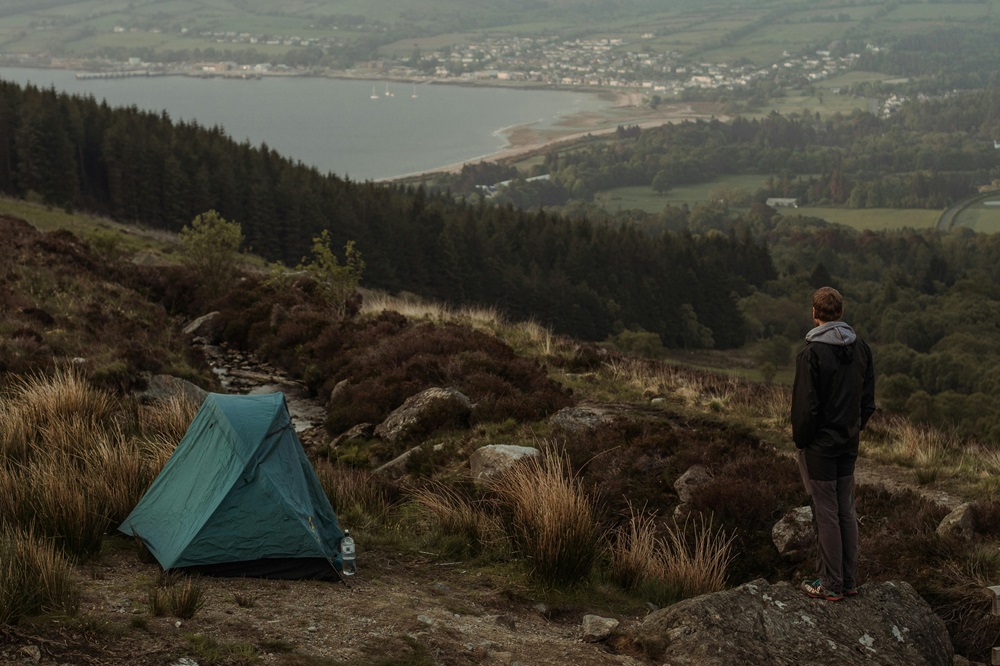
For most two-person hiker tents, the design is usually a simple two-pole dome. In practice, that gives you decent resistance up to around 40 mph if the tent is staked properly. Without solid stakes, that number drops significantly.
How much does staking actually matter for pole survival?
Stakes are doing more work than the poles are. When wind hits a tent, the stress travels through the fabric, down the pole, and into the ground. If the stake isn’t holding, the force has nowhere to go – it goes back into the pole and the connection point, which is exactly where things break.
A 2020 study from REI’s equipment team found that properly staked tents experienced pole failure at nearly double the wind speed compared to the same tent staked loosely. That’s a massive gap.
Here’s what actually matters with stakes:
- Drive them at a 45-degree angle, angled away from the tent
- Use the guylines, not just the corner stake-outs
- In soft ground, use wider sand stakes – thin wire stakes pull right out
- Pre-tension the guylines before wind hits, not after
Most people skip guylines on calm nights, which is fine. But if there’s any forecast for wind over 20 mph, those lines should be out and tensioned.
What the ozark trail 2 person hiker tent can actually handle
The ozark trail 2 person hiker tent uses fibreglass poles in most of its base configurations, which puts it in that 25–35 mph wind range before real stress kicks in. That’s honest camp-use territory – it’ll hold up fine in a breezy night at a car camping site, but it’s not built for exposed ridge camping or unexpected storms.
The hub-and-clip system common on Ozark Trail designs also means if one clip pops in a big gust, the pole loses lateral support immediately. It’s a faster failure chain than a sleeve-style pole system.
That said, for casual three-season hiking in sheltered terrain, it does the job. The issue is when people use budget hiking tents in places that need mountaineering-grade kit.
FAQ
Can a tent survive 60 mph winds?
Ans: A standard two-person hiker tent almost certainly won’t survive sustained 60 mph wind. Even quality aluminium poles at that speed require a geodesic design, solid guylines, and proper site selection. Most consumer tents are rated for much less.
What does “tent wind rating” actually mean?
Ans: Manufacturers test tents in controlled lab conditions, usually with steady airflow and proper setup. Real-world gusts are different – a 40 mph gust hits harder than 40 mph steady wind. Always treat tent wind ratings as guidelines, not guarantees.
Do thicker poles mean better wind resistance?
Ans: Not always. Pole diameter matters, but material and wall thickness matter more. A 9mm aluminium 7075 pole handles wind better than a 12mm fibreglass pole almost every time.
How do you know when poles are about to fail?
Ans: You’ll usually hear creaking before you see bending. If your poles are making noise under wind load, that’s your warning. Get the guylines tensioned immediately and consider lowering the profile if conditions worsen.
Is it worth upgrading the poles on a budget tent?
Ans: Yes, if you camp in exposed areas. You can buy compatible aluminium replacement poles for under $20–30 in many cases. For casual camping, it’s not necessary – but for mountain terrain, it’s worth it.
Whether you’re using a premium three-season tent or the ozark trail 2 person hiker tent, wind resistance comes down to three things: pole material, tent geometry, and how well you stake it out.
No tent is immune to a serious storm – but the right setup gets you a lot closer to surviving one.